Discover top-rated portable heated clothes dryers that fit apartments, RVs, dorms, and travel. This guide highlights five versatile models, their key features, and how they compare for efficiency, safety, and space-saving design. Read on to find the best option to keep your wardrobe dry and ready, wherever you are.
Summary of Selected Products:
- MOJOCO Portable Clothes Dryer — Compact, fast-drying with built-in LED UV cleaning
- KASYDoFF Portable Dryer (46 Inch) — Large capacity, 1000W, foldable rack design
- CinGiiCo Portable Dryer — 12-item capacity, two modes, quiet operation
- Nekithia Portable Dryer — Large capacity, fast dry, timer, quiet
- Stopsad 1.6 Cu.Ft Portable Dryer — 800W, 5 dry modes, compact for small spaces
MOJOCO Portable Clothes Dryer

The MOJOCO portable clothes dryer is designed for apartment living, travel, or small spaces. It claims a capacity to hold up to nine clothes and uses a combination of heat and airflow to shorten drying times, potentially around 50 minutes for typical loads. The dryer is lightweight and foldable, facilitating movement between rooms or locations. It also features a built-in LED UV system intended to refresh and sanitize garments during the drying cycle, adding an extra layer of cleanliness. Its compact design suits busy schedules and frequent travelers who need quick turnaround for daily wear.
Key considerations include energy use, noise levels, and the practicality of a 50-minute dry time for varied fabric types. The LED UV feature may appeal to households prioritizing hygiene, though users should follow garment care instructions to avoid potential fabric sensitivity. The MOJOCO model prioritizes portability and ease of setup, making it a practical option for those with limited laundry space or on-the-go lifestyles.
KASYDoFF Portable Clothes Dryer, 46Inch-1000W

The KASYDoFF model emphasizes large capacity and family-ready drying. With a 46-inch foldable design and 1000W power, it aims to support drying of up to 28 pounds of clothing in one session. The unit is described as portable and space-saving, with a foldable structure and a carrying bag for storage and travel. It also highlights safety features and multiple drying stages, along with a 67-inch tall rack configuration that accommodates a broader range of garments and towels. This model suits households needing to dry more items per cycle without repeated runs.
Considerations include electricity usage at 1000W, potential heat output in small spaces, and the need for stable placement to support longer hanging areas. The anion function claimed by some variants aims to improve fabric freshness, which may appeal to households seeking odor reduction alongside drying. Potential buyers should assess room size, socket availability, and the practicality of installing a taller rack in closets or bathrooms.
CinGiiCo Portable Dryer

CinGiiCo offers a compact dryer capable of handling up to 12 items per cycle, using a 3D heat and circulation approach to dry clothes with low noise—reported as about 44 dB. The device features two modes: a care mode for gentle drying and a quick-dry mode for faster results. It provides four timer settings (1, 2, 4, and 8 hours), enabling tailored durations based on fabric type and load size. Internal lighting is mentioned as a feature for visibility during operation. This model is positioned for users who value quiet operation and flexible timing in small spaces or dorm rooms.
Important considerations include ensuring proper wringing of garments before use to maximize drying efficiency, and understanding how the two modes might affect delicate fabrics. The noise level and timer versatility make this a viable option for apartments and shared living spaces where quieter cycles are preferred.
Nekithia Portable Clothes Dryer
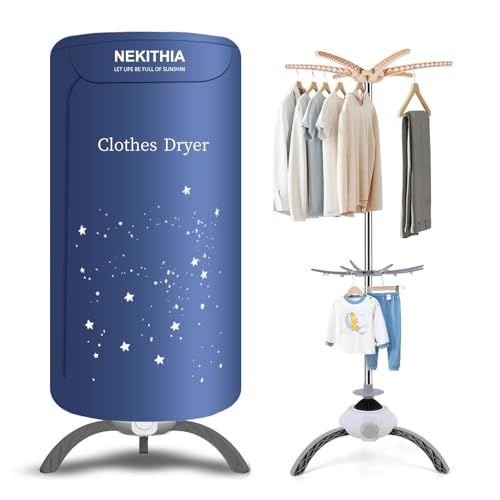
The Nekithia dryer advertises a 900W fast-drying capability with a large load capacity and a dedicated drying system designed to handle big loads efficiently. It emphasizes a compact form factor suitable for travel, apartments, RVs, dorms, and camping. The model focuses on delivering quick turnaround times for daily wear and larger items like towels or bedding, aiming to balance speed with energy use and space constraints. A key selling point is the combination of a relatively high wattage and a large capacity for a portable unit, which appeals to users balancing throughput and space.
Potential buyers should consider the unit’s footprint, heat output in closed spaces, and the durability of the loading mechanism for frequent use. As with other portable units, matching the dryer’s capacity to typical household laundry needs is essential to avoid overloading or extended cycles.
Stopsad 1.6 Cu.Ft Portable Clothes Dryer

The Stopsad model presents a compact 1.6 cubic feet capacity with 800 watts of power and five drying modes. Its size is described as suitable for apartments, dorms, or small homes, with a weight around 32 pounds that facilitates relocation within a living space. The device emphasizes versatility through multiple dry programs, which can accommodate different fabrics and moisture levels, contributing to better garment care and energy efficiency. The inclusion of a front-loading design and a compact footprint is aligned with space-conscious households looking for a dedicated drying option without a full-size electric dryer.
Considerations for Stopsad include the balance between power, cycle duration, and the variety of programs. Users should evaluate whether the five modes cover the fabrics they routinely wash and whether the unit’s dimensions fit their laundry area and doorways for installation and storage.
Buying Guide: Key Purchase Considerations And Comparisons
When choosing a portable heated clothes dryer, consider load size, space, power requirements, and fabric care needs. Here are practical angles to compare models:
- Capacity and load management: Larger family needs may favor 28–35 lb capacities or taller, multi-tier racks, while solo users may prioritize compact units with foldable designs.
- Power and energy efficiency: Look at wattage and cycle options. Higher wattage dries faster but consumes more energy; check for energy-saving modes and auto shutoff.
- Noise and vibration: For shared living spaces, quiet operation (under 50 dB) is beneficial. Consider anti-tip features and stable base.
- Drying modes and timers: Devices with multiple programs (delicate, quick-dry, extended timers) offer flexibility across fabrics. Timers help customize duration to garment thickness.
- Hygiene features: Some models include UV or deodorizing functions. Verify that any cleaning features do not degrade fabrics or produce unwanted residues.
- Portability and storage: Foldable frames, carry bags, and compact footprints improve ease of storage and travel readiness.
- Durability and warranty: Check build materials (stainless steel tubs are typically sturdier) and warranty terms for longer-term protection.
- Safety features: Overheat protection, automatic shutoff when tilted, and child-safety considerations add peace of mind for households with kids or pets.
To maximize value, compare models based on your typical laundry load, available space, and how frequently you travel or move between locations. A dryer with a balanced combination of capacity, fast drying, and safe, quiet operation tends to meet a broad set of needs for American households relying on compact, portable solutions.