Clean, great-tasting water starts with a reliable carbon block filtration system. This guide highlights five top whole-house and under-sink options that use carbon block technology to reduce chlorine, sediment, tastes, and odors, while protecting appliances and improving overall water quality. Explore consumer-friendly installations, filtration capabilities, and maintenance considerations to help you choose the right system for your household.
| Product | Your Benefit | Filter Type | Flow & Capacity |
|---|---|---|---|
| iSpring WGB22B | Whole-house protection from chlorine and sediment | Two-stage carbon block | Up to 15 GPM |
| Waterdrop TSA | 8-layer filtration; PFAS, fluoride, and taste control | Carbon block + additional media | Under-sink, modular |
| iSpring WGB21BM | Iron & manganese reduction with carbon block | Two-stage carbon block + iron/manganese filter | Up to 15 GPM |
| Membrane Solutions CTO 5 Micron | Cartridge replacement for broad sediment and chlorine reduction | 5-micron CTO carbon block | Standard 10″ housing compatibility |
| AO Smith 2.5″x10″ 5 Micron | Longer-lasting sediment reduction for whole-house use | 5-micron carbon block sediment filter | Whole-house system compatible |
Below, five selected products are reviewed with objective details to help you compare filtration performance, maintenance needs, and compatibility with typical home plumbing. Each section includes a direct link to Amazon for reference and product specifics.
iSpring WGB22B 2-Stage Whole House System
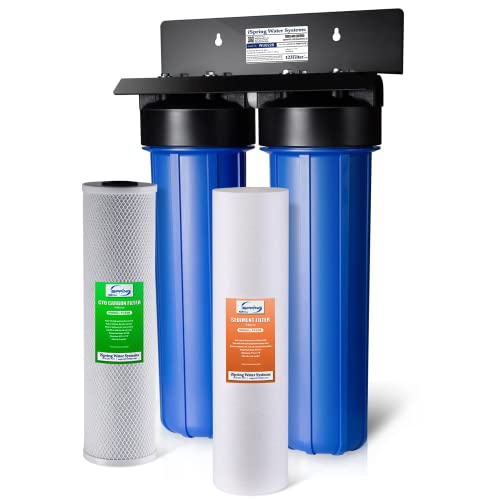
The WGB22B is designed as a main-line filtration solution that treats all household water. It combines a sediment filter with carbon block cartridges to reduce up to 99% of chlorine and significant sediment while improving taste and odor. The system operates with 1″ NPT ports and 20″ x 4.5″ cartridges, balancing filtration efficiency with minimal impact on water flow (up to 15 GPM). DIY installation is supported by manuals and online videos, making it a practical option for homeowners comfortable with basic plumbing tasks. This model also offers extended manufacturer warranty with lifetime personalized support when registered.
Key considerations:
– Pros: Whole-house coverage, strong chlorine and sediment reduction, simple DIY setup, manageable maintenance interval.
– Cons: Generally larger footprint; cartridge replacements are a regular maintenance task, and flow depends on plumbing and incoming water pressure.
Waterdrop TSA 8 Layer Under-Sink Filter System

The Waterdrop TSA is an under-sink filtration system designed to reduce PFAS, PFOA/PFOS, fluoride, chlorine, and odors. It is NSF/ANSI 42 certified and emphasizes a multi-filter approach with a focus on taste and odor improvement. Important notes indicate it is intended for cold municipal water, not suitable for well water or hot water, and it requires compatible faucet connections. The system works with 1/2″ or 3/8″ NPT threads and can be expanded with additional filter options for tailored filtration schemes.
Key considerations:
– Pros: Strong chlorine and taste improvement, compact installation, NSF/ANSI 42 certification.
– Cons: Not for well water or hot water; capacity depends on inlet pressure and faucet compatibility; filters require exact fittings for pipes and faucet connections.
iSpring WGB21BM 2-Stage Whole House System

This system combines a CTO carbon block for the first stage with a dedicated iron and manganese reducing stage. The CTO carbon block is designed to remove cloudiness, odors, and most chlorine, while the second stage targets iron and manganese to protect appliances and improve water aesthetics. The setup is pre-assembled on a mounting bracket for straightforward DIY installation, with a 1″ NPT inlet/outlet and 10″ x 4.5″ cartridges. It aims to deliver up to 15 GPM with minimal pressure loss and long filter life, which helps families with greater daily water use.
Key considerations:
– Pros: Specific iron/manganese reduction, pre-assembled for easier install, robust chlorine removal, extended filter life at higher usage.
– Cons: Iron/manganese performance depends on water chemistry; may require periodic media replacement beyond standard carbon changes.
Membrane Solutions CTO 5 Micron CTO Cartridge (6-Pack)
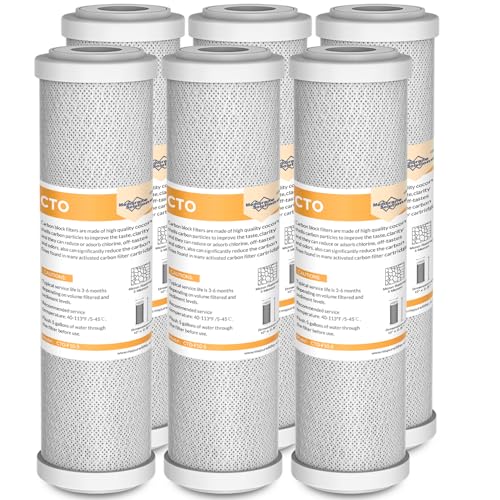
The Membrane Solutions CTO carbon block replacement is a versatile 5-micron cartridge designed for a wide range of whole-house and under-sink filtration systems. It emphasizes high adsorption capacity to reduce sediment, rust, silt, and particulates, as well as chlorine and related tastes and odors. NSF/ANSI 42 certification is noted for materials compliance, ensuring safe use in drinking water applications. The 6-pack offers cost-effective replacement intervals for households with regular filtration needs.
Key considerations:
– Pros: Versatile fit for many standard housings, strong sediment and chlorine reduction, economical replacement options.
– Cons: Some setups may require upstream sediment or post-carbon filters for comprehensive contamination control.
AO Smith 2.5″x10″ 5 Micron Carbon Block Filter

This AO Smith replacement cartridge is designed for whole-house sediment filtration. It uses a 5-micron carbon block sediment filter, specifically marketed to fit AO-WH-PREV and AO-WH-PRE housings. The cartridge aims to extend the life of downstream appliances by reducing sediment and particulate matter before it reaches taps and fixtures. It is presented as a direct-fit replacement for compatible systems, emphasizing compatibility and continued filtration performance.
Key considerations:
– Pros: Simple, direct replacement for compatible whole-house filters; improves downstream appliance protection; focused sediment reduction.
– Cons: Limited data on chlorine or taste improvement; best paired with a downstream carbon stage for comprehensive contaminant removal.
Buying Guide: Key Purchase Considerations And Comparisons
- Filtration goals: Decide whether you prioritize whole-house protection (chlorine, sediment, and taste) or targeted under-sink filtration for drinking water quality. Two-stage carbon block systems fit many homes for overall water quality, while separate under-sink units can tailor filtration to drinking water only.
- Water chemistry: Municipal water often benefits from chlorine and sediment reduction, while well water may require additional iron, manganese, or hardness management. In some cases, an iron/manganese stage or a mixed-media design improves outcomes for well water.
- Flow rate and pressure: Whole-house systems typically maintain typical flow up to 15 GPM, depending on inlet pressure and cartridge design. Undersink systems can impact faucet supply if not sized for your water line.
- Maintenance and replacement: Consider cartridge life, ease of replacement, and availability of replacement filters. A 6-pack or compatible multi-pack can lower long-term costs for high-usage homes.
- Certification and safety: Look for NSF/ANSI 42 or 53 certifications indicating performance claims related to taste, odor, chlorine, and contaminants. Check installation manuals for compatibility with your plumbing (inlet/outlet size, thread types).
- Installation approach: DIY installations work well for many homeowners, with pre-assembled units and clear manuals. Some setups may require professional installation, especially main-line systems or configurations with multiple stages.
- System footprint: Whole-house units occupy more space and may require mounting space near your main water line. Undersink units are compact but may necessitate careful routing and faucet compatibility.
- Cost of ownership: In addition to initial price, factor in cartridge cost, replacement frequency, and potential water usage impact if filter packing changes back-to-back.