For researchers and technicians needing reliable ultra-low temperature (ULT) storage, compact 20–25 liter units offer precise cooling with portable footprints. This guide highlights five suitable options from reputable manufacturers, emphasizing stability, control, and ease of use in clinical and laboratory settings. The selections balance capacity, temperature range, and accessibility to support sample integrity across workflows.
| Product | Brand | Capacity | Key Benefit |
|---|---|---|---|
| 20L Ultra-Low Temperature Freezer-86°C | LABFENG | 20 L | Precise microcomputer control and durable construction |
| VEVOR 25 L Ultra Low Temp Freezer | VEVOR | 25 L | Wide -40°F to -123°F range with digital display |
| Donpemu 25L Ultra-Low Temperature Freezer | Donpemu | 25 L | Portable and robust for lab or field use |
| VEVOR 28 L Ultra Low Temp Freezer | VEVOR | 28 L | Comprehensive temperature control and alarms |
| Accucold UFM19WLHD / UFM19W | ACCUCOLD / Summit Appliance | 18 cu ft | Reliable lab-grade performance with manual defrost |
20L Ultra-Low Temperature Freezer by LABFENG

The LABFENG model delivers -86°C (-123°F) operation with dual door gaskets and high-density insulation to minimize thermal loss. Its self-repeating refrigeration design supports stable performance under frequent use. A microcomputer control system provides accurate 0.1°C temperature display, ensuring precise monitoring of stored samples.
Durable construction includes a galvanized sprayed exterior and full copper tube evaporator for corrosion resistance. A compact 20 L footprint makes it suitable for bench-top or small lab suites, while maintaining dependable low-temperature storage for sensitive specimens.
Accucold UFM19WLHD Upright Freezer

This 18.3 cu ft upright freezer is designed for laboratory and clinical storage with stable -20°C operation. Manual defrost helps maintain temperature consistency, and a dial thermostat inside the unit reduces accidental adjustments. An external thermometer and alarm assist in real-time monitoring during busy lab workflows.
Cantilevered shelving offers flexible organization, while a flat door liner accommodates deeper trays. The automatic LED interior light improves visibility, supporting efficient inventory management in clinical settings.
VEVOR 25 L Ultra Low Temperature Freezer
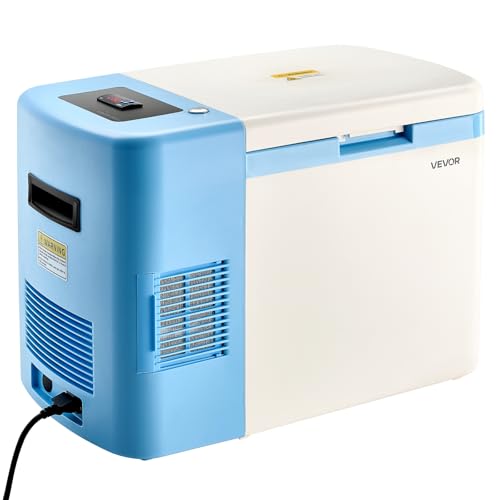
VEVOR’s 25 L model reaches -40°F to -123°F with a compact design that suits labs needing fast cooling and energy efficiency. A precise ±0.1°C microcomputer control allows real-time adjustments and monitoring, which is critical for preserving sensitive biological samples.
The unit features a customizable smart alarm, audible and visual alerts, and a keyed lock to deter unauthorized access. Its sturdy construction includes a stainless steel interior liner for durability and easier cleaning in high-demand environments.
Donpemu -86℃ Portable Lab Freezer
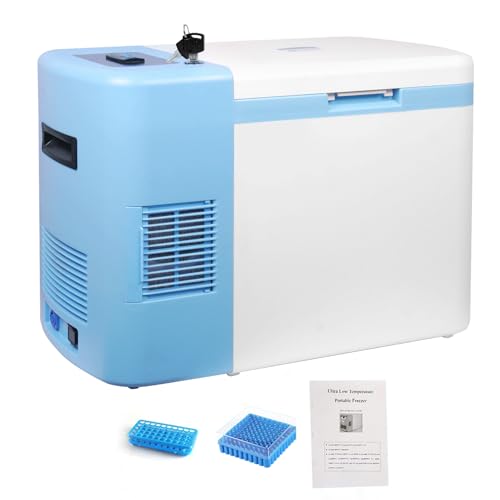
Donpemu offers a 25 L ultra-low temperature model with -86°C/-123°F capabilities. Dual-door gaskets and high-density insulation support stable cooling for sensitive samples. The microcomputer system displays 0.1°C increments and allows customizable alarms, ensuring reliable monitoring.
The design emphasizes portability, with a galvanized steel body and copper tube evaporator to withstand laboratory use while remaining relatively easy to relocate for field or shared-space environments.
VEVOR 28 L Ultra Low Temperature Freezer

This 28 L unit extends capacity while retaining an ultra-low temperature range of -40°F to -123°F. A microprocessor-based digital interface provides precise temperature adjustment and real-time monitoring. The unit includes a robust alarm system for unauthorized access and sample protection.
Rollers improve mobility, making it easier to reposition the freezer within dense lab layouts, and a stainless steel liner enhances durability and sanitation in clinical settings.
Buying Guide: Key Purchase Considerations
- Temperature range and stability: Confirm the freezer’s lower limit and how quickly it reaches target temperatures. Look for units with ±0.1°C precision and stable defrost methods (manual or automatic).
- Capacity vs. footprint: Choose a model that fits available bench space or cabinet height while providing sufficient space for sample tubes, vials, and racks. Consider future expansion needs.
- Control interface: Digital displays, alarm customization, and remote monitoring features help maintain sample integrity. A lockable control panel offers additional security.
- Defrost type: Manual defrost reduces energy consumption but requires more upkeep. Frost-free systems simplify maintenance but can introduce minor temperature fluctuations.
- Durability and materials: Stainless steel interiors and copper evaporators improve longevity and ease cleaning in clinical environments.
- Portability and installation: If space is limited, prioritize compact designs with casters or rollers for easy repositioning.
- Alarms and monitoring: Audible/visual alarms, door-open alerts, and external thermometers help prevent unnoticed temperature excursions.
- Safety features: Look for door seals, anti-tip shelves, and secure access controls to protect valuable samples and comply with lab protocols.
- Warranty and service: Check warranty length and availability of local service for maintenance, calibration, and part replacement.
These five models provide a spectrum of capacities and features to support reliable ultra-low temperature storage in American laboratories. When selecting, balance sample requirements, workflow demands, and facility constraints to optimize both performance and cost of ownership.